Anatomy of a Circuit Breaker
Inside a Circuit Breaker: How It Protects Your Home From Power Surges
Most homeowners only think about their circuit breakers when a light goes out or a major appliance suddenly stops working. You walk to the panel, find the switch that flipped, reset it, and carry on.
But behind that simple motion is one of the most important safety mechanisms in your home the circuit breaker.
Circuit breakers prevent electrical overloads, detect faults, reduce fire risks, and protect your wiring and appliances against damage. In cities like Houston, where homes experience extreme heat, lightning surges, power grid fluctuations, and high-energy appliances, breakers work harder than ever.
Understanding how a breaker works gives you insight into your home’s overall safety and helps you know when it’s time for inspection, repair, or an upgrade.

The Purpose of a Circuit Breaker: Your First Line of Defense
A circuit breaker has one job: stop unsafe electrical flow before it leads to overheating, fire, or equipment damage.
When too much current passes through a circuit, or when a fault occurs (like a short or arc), the breaker trips automatically shutting off electricity to that part of the home.
Breakers prevent:
Electrical fires
Melted wiring
Appliance damage
Overheating during high load usage
Shock hazards
Surge-related destruction
In Houston, heavy storms, aging infrastructure, and high air-conditioning demand make breakers trip more often which is a sign they’re working properly.
But repeated trips signal deeper problems that need professional attention.

Anatomy of a Circuit Breaker
Even though breakers look simple from the outside, inside they contain a sophisticated combination of mechanical and electrical components designed to react in milliseconds.
Let’s break down the essential parts:
The Switch Handle
This is the part homeowners interact with. It displays the breaker’s position:
ON
OFF
TRIPPED (often a middle position)
The switch handle also allows manual reset after a trip but only once the underlying issue is fixed.
Thermal Trip Mechanism
Inside every breaker is a bimetal strip made of two metals that expand at different rates when heated.
When a circuit is overloaded like too many appliances plugged into one outlet the strip heats up, bends, and triggers the breaker to trip.
This prevents long-term overheating that can melt insulation and start fires.
Magnetic Trip Mechanism
This component protects against sudden surges or spikes.
A coil inside the breaker creates a magnetic field when current spikes rapidly, such as:
Lightning strikes
Utility grid switching
Power returning after an outage
Equipment failure
When the magnetic field gets strong enough, it instantly pulls a lever that disconnects power — protecting your home in microseconds.
Surges are common in Houston, which is why Texas electrical code requires whole-home surge protection in addition to breakers.
Arc Fault Detection (AFCI Breakers)
Modern breakers required in many Texas homes contain arc detection sensors.
An arc fault is an electrical spark caused by:
Damaged wires
Rodents chewing insulation
Loose connections
Old or aluminum wiring
Cracked outlets
AFCI breakers identify the signature of an arc and trip before a fire can ignite.
They are essential in older Houston homes with aging wiring or homes built before AFCI code adoption.
Ground Fault Detection (GFCI Breakers)
GFCI breakers protect against shock hazards, especially in wet areas.
When they sense a difference between incoming and outgoing current even as small as 4–6 milliamps they trip instantly.
Texas code requires GFCI protection for:
Kitchens
Bathrooms
Garages
Laundry rooms
Pools/spas
Outdoor circuits
If your home is older and lacks GFCI breakers or outlets, Unity Services can upgrade them quickly.
Internal Contacts & Metal Latch
These components create the physical opening and closing of the electrical path. They must function reliably hundreds or even thousands of times over their lifespan.
Humidity, heat, and corrosion (extremely common in Houston) can weaken these parts over time.

The Role of Breakers in Texas Surge Protection Requirements
Texas has adopted strict electrical safety standards under the National Electrical Code (NEC), including:
✔ Whole-home surge protection (SPD) is mandatory on all new panel installations or replacements.
Breakers alone cannot stop large surges especially lightning surges, which can exceed 30,000 amps.
A circuit breaker is NOT designed to absorb that kind of energy.
A breaker responds to:
Overloads
Shorts
Arc faults
Ground faults
But not the high-voltage spikes caused by storms.
That’s why the Texas code requires:
One or more whole-home surge protectors installed directly on the panel
Surge protection for major equipment like HVAC systems
Surge-rated panels for new construction
Houston is one of the most lightning-prone metro areas in the U.S., so compliance is critical.
Unity Services installs only UL-listed surge protection devices designed for Texas power conditions.

Why Breakers Trip: Common Causes in Houston Homes
Houston homeowners often call Unity Services asking, “Why does this breaker keep tripping?”
Here are the most common reasons:
1. Overloaded Circuits
Running too many devices on one circuit overwhelms the breaker.
Common offenders:
Space heaters
Hair dryers
Microwaves
Window A/C units
Gaming systems
Shop tools
Overloads are especially common in older homes with original wiring.
2. Short Circuits
A short occurs when a hot wire touches a neutral or ground wire. This causes a sudden spike in current and the breaker instantly trips.
Short circuits should be treated as urgent they indicate damaged wiring.
3. Arc Faults
AFCI breakers protect against dangerous sparking in the walls. These sparks can ignite insulation and framing in seconds.
Arc faults are common in:
Older wiring
Loose outlets
Aluminum wiring homes
Homes with rodent activity
Poorly installed DIY circuits
4. High Outdoor Temperatures
Excessive heat increases electrical resistance. Breakers in garages or outdoor panels may trip more frequently during Houston summers.
5. Faulty Appliances
A damaged appliance can repeatedly overload or short a circuit.
Unity Services often diagnoses:
Failing HVAC compressors
Faulty dryers
Bad pool equipment
Old refrigerators
6. Lightning or Power Surges
Without whole-home surge protection, breakers can trip due to surges traveling in through utility lines.
This is extremely common during Houston thunderstorms and hurricane season.
Types of Breakers Found in Houston Homes
Different circuits require different breakers for safety and compliance in Texas.

Standard Single-Pole Breakers (120V)
Used for:
Outlets
Lights
Small appliances
Amperage ratings typically range from 15–20 amps.
Double-Pole Breakers (240V)
Used for:
Air conditioners
Ovens
Dryers
Water heaters
EV chargers
Pool heaters
Double-pole breakers handle heavy electrical loads common in Houston homes.
AFCI Breakers (Arc Fault Circuit Interrupters)
Required in:
Bedrooms
Living rooms
Dining rooms
Hallways
If your home lacks AFCIs, it is not up to current code.
GFCI Breakers (Ground Fault Circuit Interrupters)
Required for:
Kitchens
Bathrooms
Garages
Pools
Outdoors
Laundry areas
If your outlets don’t have GFCI symbols or buttons, you likely need an update.
Dual-Function AFCI/GFCI Breakers
These combine the protection of both AFCI and GFCI into one device. Increasingly standard in new Texas construction.
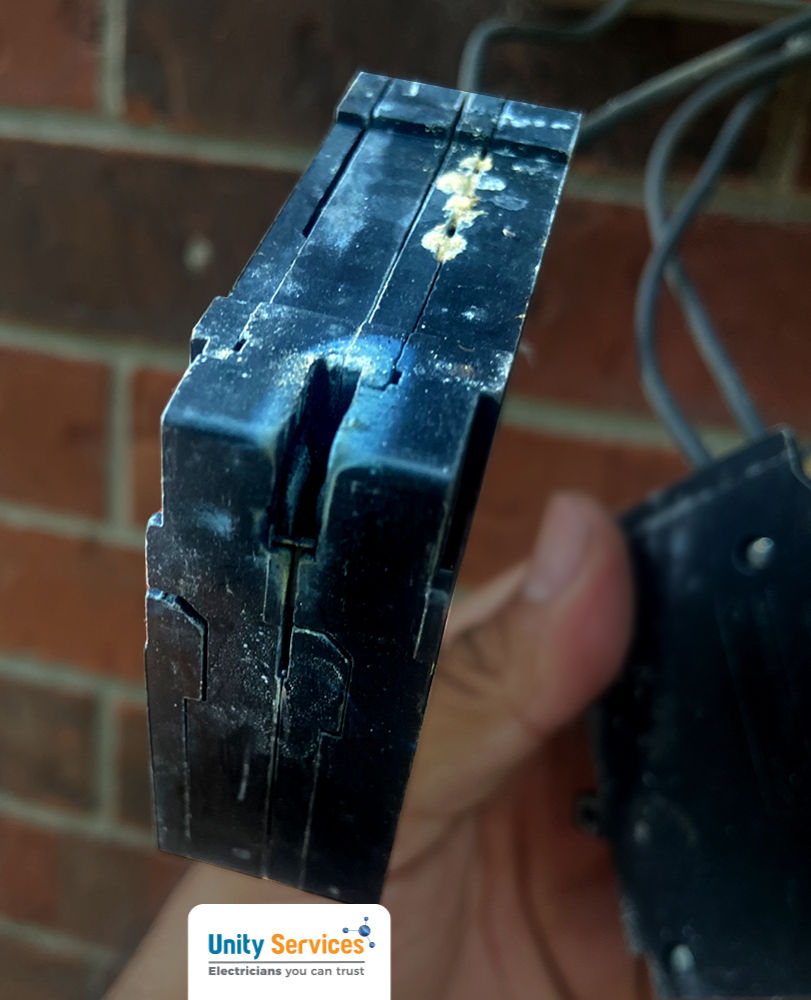
Signs a Breaker Is Failing
If your breaker is worn out, it may not trip when it should creating a major fire hazard.
Warning signs include:
Burning smell
Breaker feels hot
Visible scorch marks
Buzzing or humming
Frequent unexplained tripping
Breaker won't stay reset
Flickering lights on that circuit
Unity Services can test each breaker with load equipment to confirm whether replacement is needed.
Why Breaker Age Matters
Breakers typically last 20–30 years, but Houston’s climate shortens that lifespan significantly.
Humidity corrodes the internal metals. Heat weakens plastic housings. Lightning surges damage internal coils.
If your home was built before 2000 and still has the original breakers, it is time for an inspection.
How Unity Services Protects Your Home
Unity Services provides full-cycle breaker diagnostics and upgrades, including:
Thermal readings
Trip testing
Load calculations
Surge protector installation
Replacement of outdated breakers
Panel upgrades for modern code compliance
We ensure your breaker system is built to withstand Houston weather, Texas code requirements, and modern energy demands.

Q&A for Homeowners
Q1: How do I know if I need new breakers?
If your breakers trip frequently, feel warm, buzz, or appear discolored, they should be inspected. Breakers in homes over 20 years old should be evaluated by a licensed Houston electrician.
Q2: Will surge protection replace the need for AFCI or GFCI breakers?
No. Surge protectors stop voltage spikes. AFCI and GFCI breakers protect wiring and occupants. Texas code requires all three working together.
Q3: Is it safe to keep resetting a breaker?
Only once. If it trips again, something is wrong continuing to reset it can cause overheating or fire.


Comments